Pass the information, not just the conclusion.
One player does not have to know the whole solution to contribute a useful detail. Describe something your partner can compare with their own view. Start with its position relative to a landmark, then its distinguishing shape or state. Ask the partner to repeat the relevant detail before acting.
- Instead of an order: explain the observation that led to it.
- Instead of several changes: agree one action, then report the result.
- Instead of assuming agreement: ask what the partner sees now.
What has been announced about the tools?
The official overview gives each explorer a walkie-talkie and a distinct tool. The developer interview gives examples such as creating boxes or platforms and pulling objects. Those examples explain the cooperative premise; they do not establish the controls or a permanent A/B ability assignment.
The official description introduces puzzles involving time, gravity and space. Prepare to compare what each side sees and what changed after an action. Do not turn a general ability description into a room solution.
For the voice link itself, the developer has described a radio display and proximity communication. The voice feedback guide separates those cues from ordinary microphone/output checks.
Agree what “left” means before using it.

Choose a doorway, panel or other visible landmark as the reference. Then say which side of that reference you mean. If the partner cannot find the same landmark, describe a second feature before adding more directions.
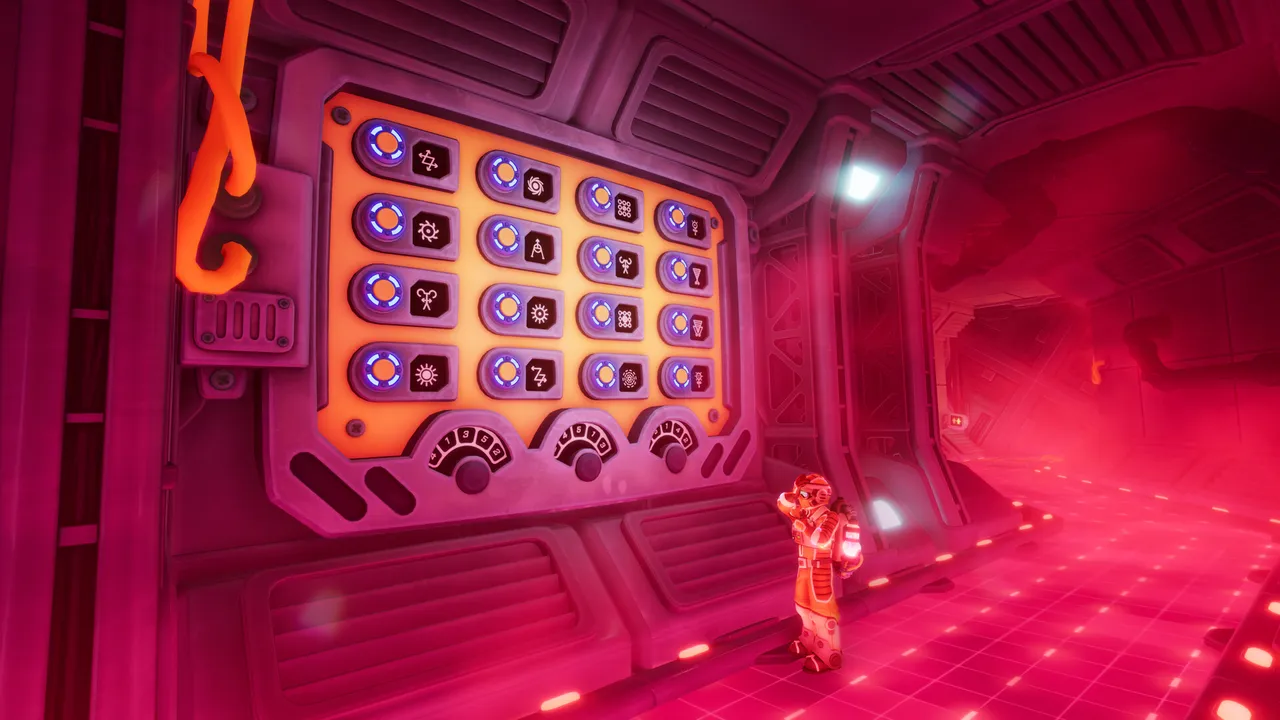
The scene shows differently oriented surfaces; it does not tell you which button changes gravity, which explorer controls it or how a specific room is solved. Use the image to understand the communication problem, not to guess an interaction.
Reset the conversation without restarting the puzzle.
- Stop giving new actions.Each player names what they currently see and what changed last.
- Separate observation from theory.“This changed” and “I think we need this” are different statements. Let your partner confirm the observation first.
- Choose one uncertainty.Ask the smallest question that would change the next action, rather than repeating every detail at once.
- Try one agreed step.Report the result, even if nothing happened. A failed expectation is useful context for the next exchange.
If the problem is hearing the exchange rather than understanding it, run the sound-path checks. If you are still preparing to play, start with the two-player checklist.